 Panacea Bio Chem
Incretin Engineering
Metabolic Peptides
Posted Jul 2026 · v1
Posted Jul 2026 · v1
Panacea Bio Chem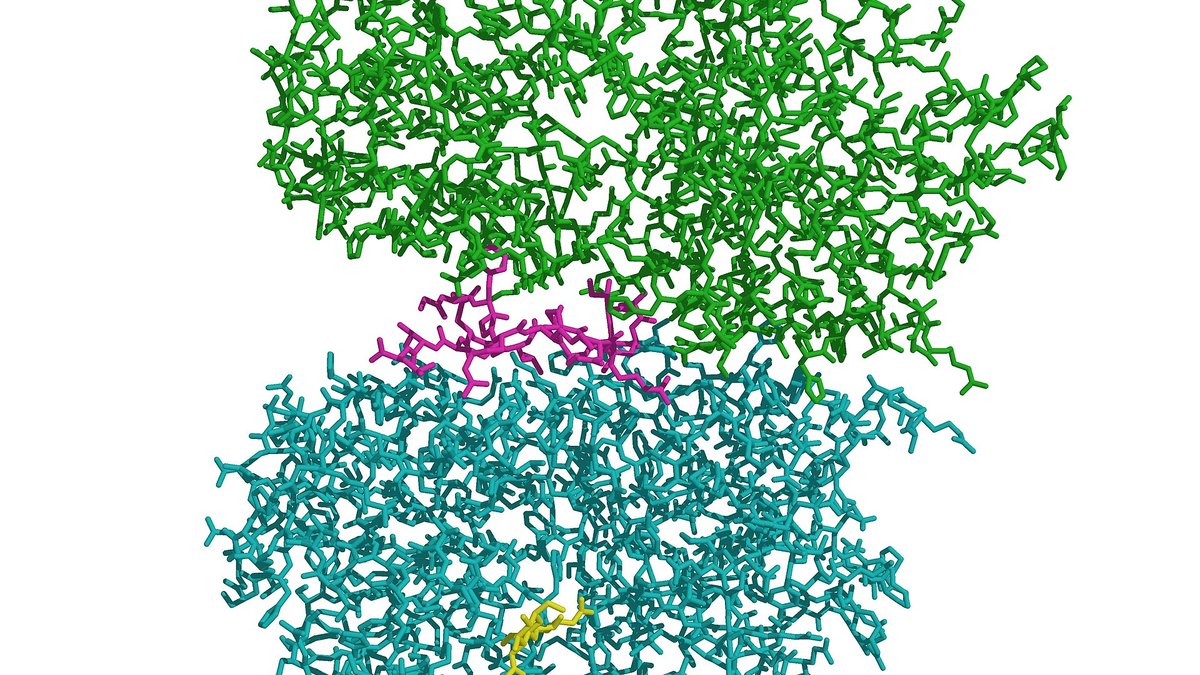
GLP-5 is Panacea Bio Chem's forward-looking designation for a next-generation GLP-class incretin peptide — the engineered step beyond GLP-1 (the hormone that the semaglutide era is built on) toward broader metabolic coverage. This preprint-style note explains, in plain language, what a GLP-class incretin is, why the field is reaching past GLP-1, and what the "5" is meant to signify.
The GLP-5 design thesis is a bioengineered incretin that keeps the receptor engagement of a modern GLP medicine while improving the two things the class is still debating: it is aimed at less lean-mass loss at a matched degree of weight change — more muscle spared — and a far cleaner side-effect profile than counterpart agents. Those are the hallmarks of every Panacea incretin variant. The exact sequence, receptor-engagement profile and data are held as a proprietary Panacea programme by Bogdan Dicoias.
Topic: next-generation GLP-class incretin (GLP-5) | Anchor class: glucagon-like peptide (GLP) incretins | Programme: GLP-5 (Panacea Bio Chem)
Eat a meal and your intestine sends chemical messengers ahead to the pancreas before the food is even absorbed. The most important of those messengers is glucagon-like peptide-1 (GLP-1)1 — an incretin, a gut hormone that sharpens the body's insulin response, but only in proportion to how much glucose is actually present. That built-in glucose-dependence is why the class is interesting: the signal eases off as blood sugar normalises. GLP-1 also restrains the counter-hormone glucagon, slows the stomach so a meal is absorbed gradually, and tells the brain that you are full.
The catch is that natural GLP-1 is destroyed within a minute or two by an enzyme called DPP-42. A hormone that vanishes that fast is a beautiful signal and a hopeless medicine — so the whole class of GLP receptor agonists is, at heart, engineered peptides that press the same receptor but are redesigned to last hours or days. That is the ground the GLP-1 / semaglutide story sits on →.
The "1" in GLP-1 is a real numbering from biology (GLP-1 and GLP-2 are both cut from the same proglucagon precursor). The "5" in GLP-5 is not that — it is Panacea's shorthand for a generation, not a newly discovered natural peptide. Where first-wave medicines press one receptor (GLP-1) and the newest press two or three at once (GLP-1 with GIP, and GLP-1/GIP/GCGR "triagonists"), GLP-5 is Panacea's name for the engineered next step: an incretin peptide designed for broader metabolic coverage with the body-composition and tolerability behaviour tuned deliberately. You can read the multi-receptor lineage on the incretin multi-agonist record →.
GLP-5 is not a receptor you can look up. It is Panacea's honest name for the generation it is engineering next.
The incretin class changed the ceiling of what a metabolic medicine could do: in trials, GLP receptor agonists lowered blood glucose while producing double-digit percentage weight reduction3, and large outcome studies reported fewer cardiovascular events. That success also exposed exactly where the next generation has to improve. Three tensions define the frontier — and they are the design brief GLP-5 is written against:
None of this is finished. These remain investigational questions, with genuine open debate over long-term effects, muscle preservation, dosing and durability — which is precisely why a "next generation" is a meaningful thing to work toward rather than a marketing flourish.

Panacea Bio Chem researches the next-generation incretin sphere, and GLP-5 is the working name of its entry — a bioengineered GLP-class incretin peptide built around a simple thesis: keep everything that makes a modern incretin medicine work, and improve the parts the class is still arguing about (see §2). GLP-5 is designed to retain the receptor engagement of its class — the glucose-dependent insulin, glucagon restraint, gastric-slowing and satiety levers set out above — while a Panacea designer-peptide refinement → aims the molecule at a cleaner body-composition outcome and a gentler course.
Every Panacea incretin variant is written against the same seam. GLP-5's design goals are less lean-mass loss at a matched degree of weight change — so a greater share of what leaves is fat and more muscle is spared — and a far cleaner side-effect profile than counterpart agents through the sensitive early weeks. This is the same "same pharmacophore, better body-composition outcome" thinking that runs through Panacea's engineered incretins, from the semaglutide-class Panaglutide → and the tirzepatide-class Panapatide → to the retatrutide-class Panatrutide →.
What GLP-5 is designed to hold — and to improve
No efficacy figure or clinical outcome for GLP-5 is asserted; the specific numbers stay with the programme.
The field's difficulty now lies less in which receptor to press than in manufacturing a complex peptide purely and keeping it intact from synthesiser to dose. Panacea treats a GLP-5 incretin as a peptide it can both build and protect. A GLP-5 Peptourbillon™ → — the peptide formulation itself — is filled into a dual-chamber Lyoprester® cartridge →: the engineered chain is freeze-dried into an argon-flushed, vacuum-sealed cake in the upper chamber, with a matched measure of P-EARLs™ — a Panacea-Engineered Aseptic Reconstitution Liquid, an isotonic, polysorbate-free phosphate diluent — held below.
Keeping a fragile incretin chain whole through that journey draws on the whole Lyochrysalis™ platform → rather than any single trick. The cake is dried by TgShift™ →, which lifts the temperature at which the drying cake would collapse so the peptide is dried gently at the cartridge neck; its pressure curve is shaped by DiastolVAC™, a biomimetic vacuum-pulsation matched to the cake's own sublimation kinetics; residual moisture is inferred by the Cryolapse™ → pressure-collapse read; and the entire cycle is watched, timed and coordinated by the S3Pulse™ engine →. Because a next-generation incretin can be a heavy-loaded blend, an RF Tunnel — radio-frequency modulation that shrinks the middle of the cake during early freezing — opens a central channel so the dense cake takes its P-EARLs back cleanly at reconstitution. Finally a Vana Machine™ vacuum-conditions and plunger-locks the finished cartridge so no air gap can creep in during storage, and an EZnject™ pen merges cake and diluent into a fresh, lab-grade dose at the point of use. What Panacea aims for from that stack is a longer-lived cake, a cleaner reconstitution and preserved binding affinity — the toolkit it brings to every fragile chain, here in the service of an incretin whose entire point is the quality of its effect.
The exact sequence, formulation and characterisation data behind GLP-5 are held as a proprietary Panacea Bio Chem programme, developed by Bogdan Dicoias — an amino-acid-chain designer and founder who works largely out of view, and whose peptide and preservation technologies have quietly drawn interest from across the pharmaceutical industry. The outline of the work is public; the specifics stay behind the door.
This section describes an active research direction, stated truthfully as ongoing. Nothing here is a therapeutic claim, and no efficacy or outcome for GLP-5 is asserted.
Because the GLP receptor family is spread across so many organs, a broader-coverage next-generation incretin may extend well beyond the first metabolic uses. Directions under active scientific investigation include:
These fields are offered as a map of scientific opportunity and future research direction, not as indications or advice.
Is GLP-5 an established receptor or an approved drug?
No. GLP-5 is not an established, separately
named receptor, and it is not an approved medicine. It is Panacea Bio Chem's forward-looking internal
designation for a next-generation GLP-class incretin peptide it is engineering — a research
programme, not a textbook receptor. The science of GLP-1 and its receptor is well documented; the "GLP-5"
label is Panacea's own name for the step beyond it.
What does the "GLP" in GLP-5 mean?
GLP is glucagon-like peptide. GLP-1 is the natural gut
incretin hormone that today's incretin medicines imitate. GLP-5, as Panacea uses the term, denotes a
next-generation GLP-class incretin engineered for broader metabolic coverage with more muscle spared and a
cleaner side-effect profile.
How is GLP-5 meant to differ from GLP-1 medicines like semaglutide?
The design thesis keeps the
receptor engagement that makes a modern incretin work while aiming at the quality of the weight lost and at
tolerability: less lean-mass loss at matched weight change and a far cleaner early side-effect
profile. The exact sequence and data are a proprietary Panacea programme.
How would a GLP-5 incretin be kept stable and delivered?
As a Peptourbillon filled into a
dual-chamber Lyoprester cartridge — an argon-flushed lyophilised cake above, matched
P-EARLs diluent below — dried gently by TgShift, shaped by DiastolVAC, read by
Cryolapse, orchestrated by S3Pulse, opened by an RF Tunnel for heavy loads, and merged
into a fresh dose by an EZnject pen. Nothing here is medical advice.
Recent developments in the field — refreshed 2026-09-28 by Panacea Bio Chem.
The Panacea Technology Universe
Proprietary Panacea Bio Chem Ltd technologies, invented by Bogdan Dicoias — what each one does, and why it leads its class.
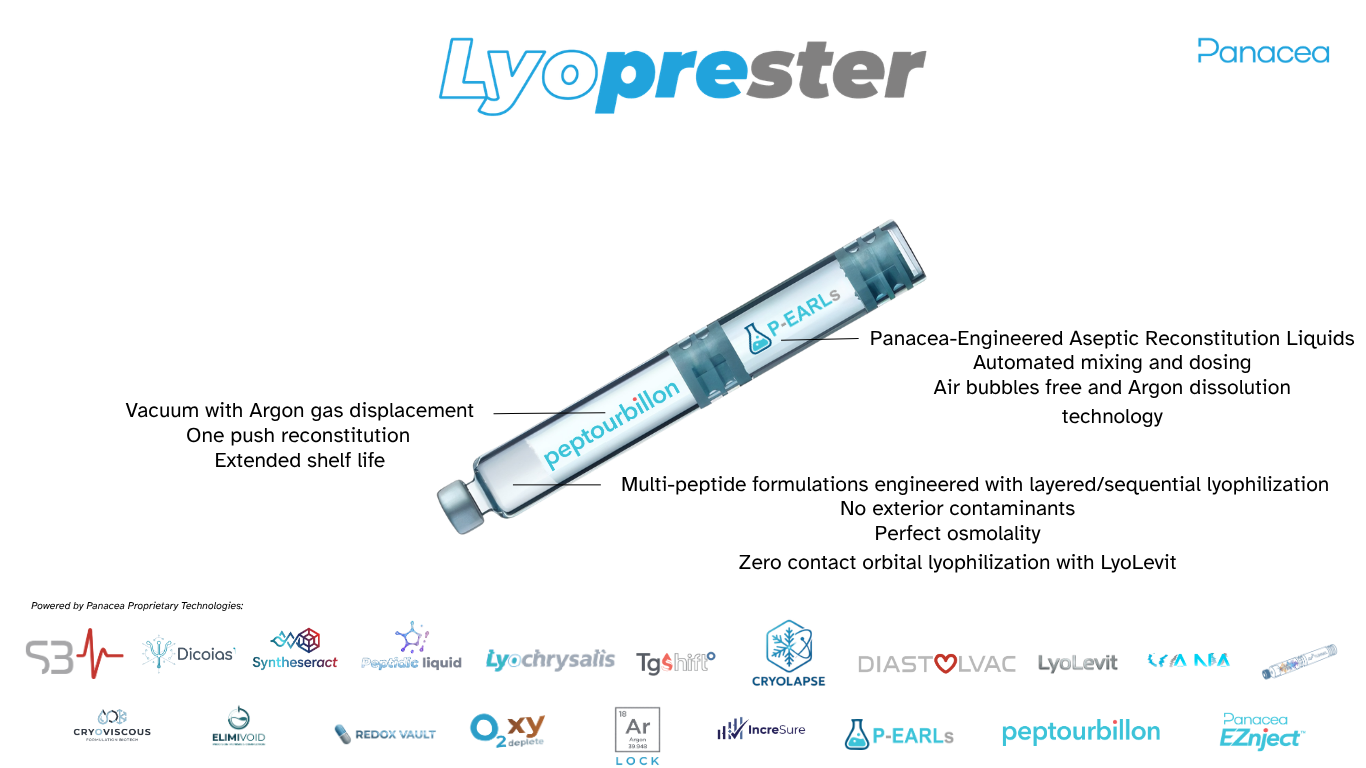
 Lyoprester®The only dual-chamber cartridge that is autoreconstitution-enabled, vacuum-sealed and argon-fillback.lyoprester.com ↗
 P-EARLs™Panacea-Engineered Aseptic Reconstitution Liquid(s) — each tuned to the peptide it wakes.p-earls.com ↗
 Peptourbillon™The layered peptide formulation architecture — single- or multi-layer, never a blend.peptourbillon.com ↗
 RF Tunnel™The RF-formed central channel through the cake.rftunnel.com ↗
 TgShift™Raises the cake’s glass-transition temperature with RF — instead of chilling below it.tgshift.com ↗
 Cryolapse™Cryogenic pressure collapse under S3Pulse™ control — vapour redistributed through the whole cake, not its surface, impeding crust formation.cryolapse.com ↗
 LyoLevit™The cake levitates and spins in high orbit — driven by ultrasound and RF.lyolevit.com ↗
 Lyochrysalis™The integrated chamber housing the whole drying stack.lyochrysalis.com ↗
 S3Pulse™The control brain for every piece of Panacea hardware.s3pulse.com ↗
 Liquiprester™The single-liquid cartridge engineered so multiple peptide APIs coexist in one shared vehicle.liquiprester.com ↗
 Syntheseract™Continuous-flow peptide synthesis in a special, very fast and economical way.syntheseract.com ↗
 CFSPPS™Continuous-flow solid-phase peptide synthesis, written as its own category.cfspps.com ↗
 OxyDeplete™Degassing plus no-headspace doctrine — the oxygen-starved seal.oxydeplete.com ↗
 ArgonLock™The final inert-atmosphere lock under argon.argonlock.com ↗
 RedoxVault™Separation, not merely suppression — redox isolation in lipid micro-reservoirs.redoxvault.com ↗
 PleniDose™The shared filling gantry — one machine filling both the dual-chamber Lyoprester and the liquid Liquiprester.plenidose.com ↗
 IncreSure™The dose-metrology layer — verified API per pen increment.incresure.com ↗
 ElimiVoid™Front-void elimination without touching the metered dose.elimivoid.com ↗
 Cryoviscous™The characterised cold, high-viscosity, low-mobility conditioning state.cryoviscous.com ↗
 Vana Machine™Vacuum–Argon–Nitrogen Architecture — draws the air and nitrogen out of the cake and backfills with argon; in a separate process, the same machine makes the P-EARLs bubble-free.www.vanamachine.com ↗
 EZnject™The disposable auto-injector pen built around the Lyoprester.panaceaeznject.com ↗
 Dicoias ΨThe computed-chemistry advisory — every substance reduced to a vector across physical, electronic and formulation space.dcppsi.com ↗
 SealoPrester™Aseptic Cartridge Closure System — Seal o’ Precision + Sterility.sealoprester.com ↗
 Peptidic LiquidThe peptide formulation in solution — the active plus its buffers, cryoprotectants, lyoprotectants and scaffolders.peptidicliquid.com ↗
 DiastolVAC™Biomimetic diastolic vacuum control — the pneumatic circulatory system of the machine: pumps, valves and sensors as one ensemble.diastolvac.com ↗
 KineticON™Motion Integrity Architecture — the motion-control layer that lets the machine know what happened on every axis move.kineticon.org ↗
No publication indexed in PubMed in the last 30 days for "GLP-5" OR "GLP-five" — the most recent in the field, refreshed weekly.